Hi, I’m Sophia Nasibdar.
I fell in love with finance the way other girls fall in love with novels. Then I started thinking about who didn’t get to read it.
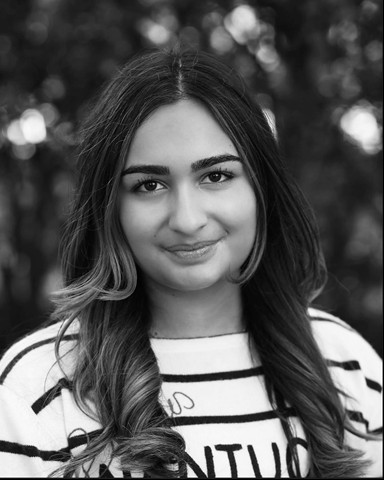
I’m a student at National Cathedral School in Washington, D.C., Class of 2028. I have endless love for finance and French. Finance, and economics with it, partly because I enjoy working through numbers and partly because the questions get complicated very quickly. Who has choices? What makes a decision difficult? How do you explain something without making it sound more confusing than it needs to be?
I grew up watching Shark Tank with my dad, and somewhere between the pitches and the deals I found a language I liked: the language of running a thing yourself. I read my way into personal finance, business, and entrepreneurship late at night, with a notebook beside me, underlining everything.
What I kept returning to were the women who got there first. The founders, the operators, the women who built something out of very little and didn’t apologize for wanting more. I wanted to give the chapter I’d grown up reading to women who had never been handed it, especially the ones beginning again in a new country, with everything to learn at once.
The Means of Her Making is my financial-literacy initiative. I wanted a practical way to work on that last question with organizations that already serve women in their communities.
In {{ zaila.monthYearLabel }}, while I was a sophomore, I taught an online class through Zaila Collection for {{ zaila.attendanceProse }} Syrian refugee women in Turkey. An Arabic interpreter helped make the session accessible across language. We spent {{ zaila.teachingMinutes }} minutes on introductory financial concepts, including credit, debt, and interest.
In {{ sahara.monthYearLabel }}, I taught a {{ sahara.teachingMinutes }}-minute class for {{ sahara.attendance }} students through SAHARA in Virginia. That time, I was there in person. The presentation focused on financial literacy as part of independence, safety, and the ability to consider new opportunities.
In July 2026, I also volunteered with the Creative and Performing Arts Center (CAPAC) in Prince William County, helping distribute financial-literacy books. A class ends; a book stays on the shelf for the evening someone actually needs it.
I’m a student, and I say so in class. When a question needs a local expert, I point to one. What I can do is choose examples that fit the room, explain a term twice when it needs it, and leave people with a page they can come back to. With SAHARA, that’s where the next classes are headed.
Outside this project, French is the other thing I can’t stop doing; I speak it well and read it for pleasure. I’m interested in history, and I write about economics and culture for Helmet to Heels. I also ride, row, sing, and make Pinterest boards. The boards probably explain some of the color choices here.
Sophia Nasibdar
Why “The Means of Her Making”?
“Means” can be money, but it can also be the tools to do something. I like that the name leaves the making to her. The point is to offer clearer information and practical ways to think through a decision, while leaving room for each woman’s own priorities.
Mission
Make practical financial education easier to access for women navigating unfamiliar money decisions, through community classes and clear resources they can return to.
Vision
A future in which more women have the understanding and support to make financial choices on their own terms.
Financial education is one useful part of that. People also need opportunities, reliable services, and circumstances that give them room to act.
How I want to do the work
Make room for the question.
An introductory class should feel like a place where asking for a simpler explanation is welcome.
Work with the setting.
A useful example needs to fit the people, language, and financial system involved. One presentation won’t fit every class unchanged.
Keep improving the material.
I want to find out what needs another explanation and give that part more attention next time.
Leave the choice with her.
People bring their own experience and priorities. The class should help them think through a decision without assuming the answer for them.